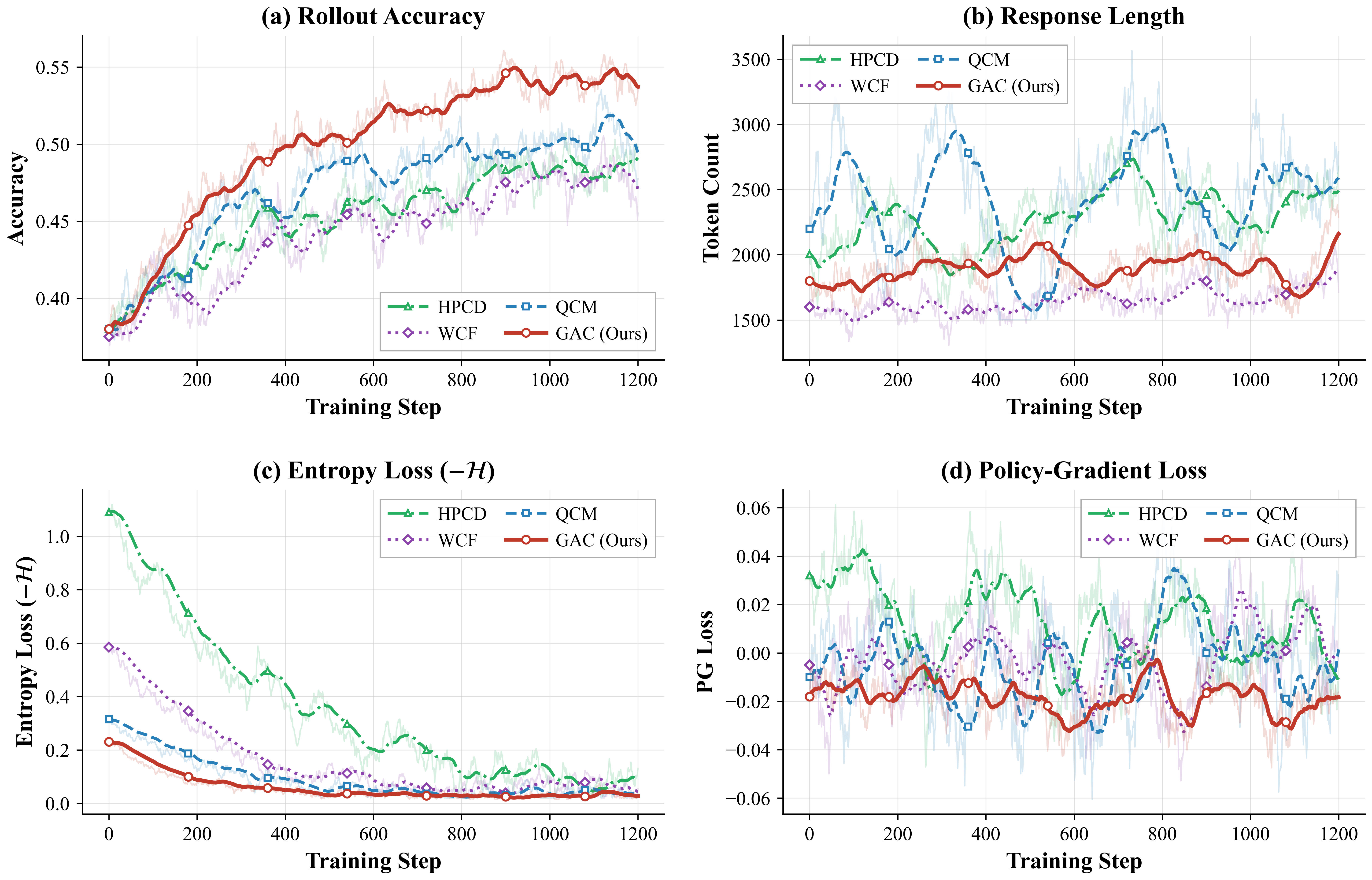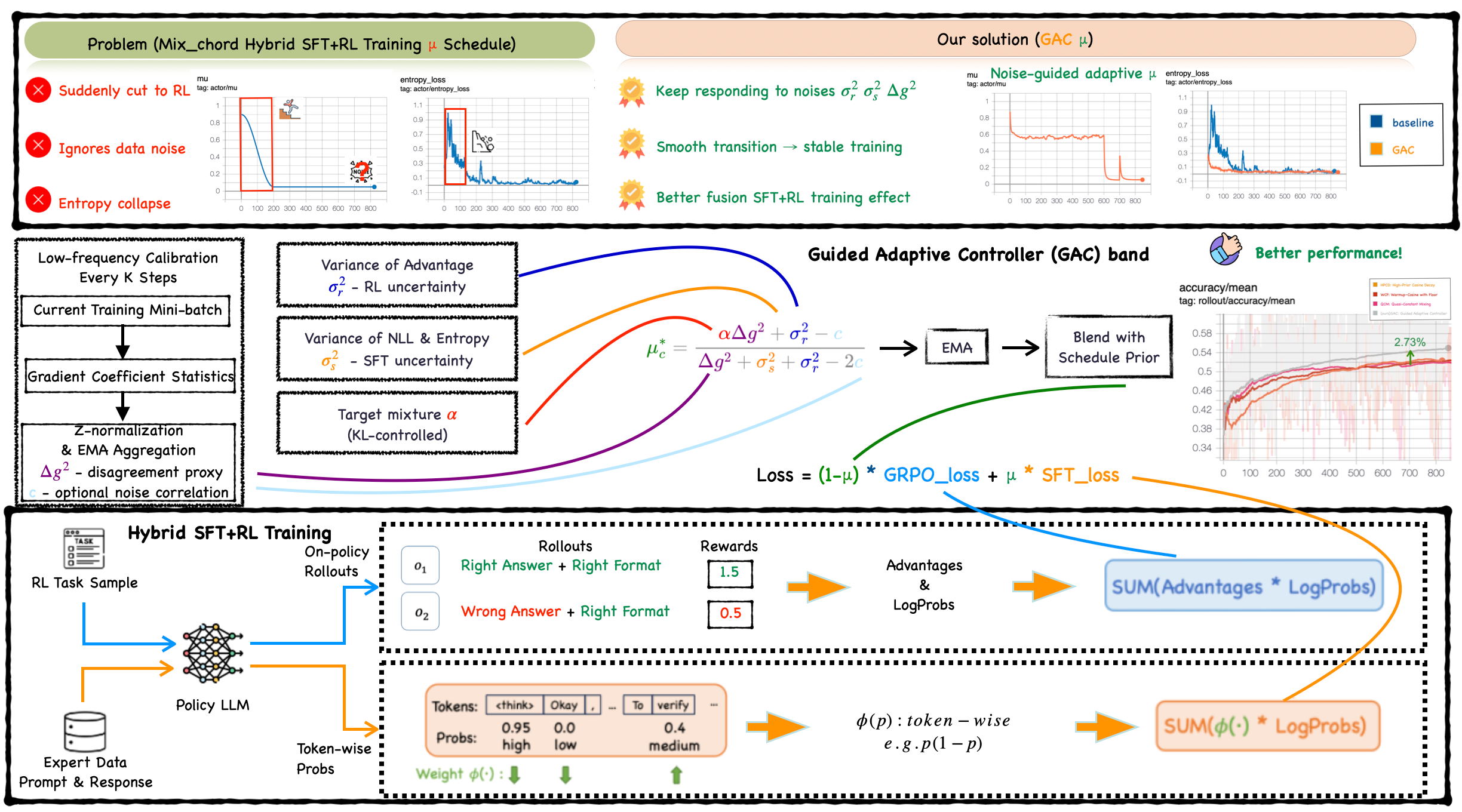
Hybrid post-training that combines supervised fine-tuning (SFT) and on-policy reinforcement learning (RL) is the standard recipe for aligning large language models. Yet the mixing weight μ that balances the two signals is almost always a fixed, hand-tuned schedule. This is fragile: when RL noise spikes, or when the SFT expert starts pulling the policy in a direction that disagrees with the reward, a static μ over-commits to whichever side is currently less reliable.
We cast SFT–RL mixing as a minimum-mean-squared-error gradient estimation problem and derive a closed-form optimal mixing weight:
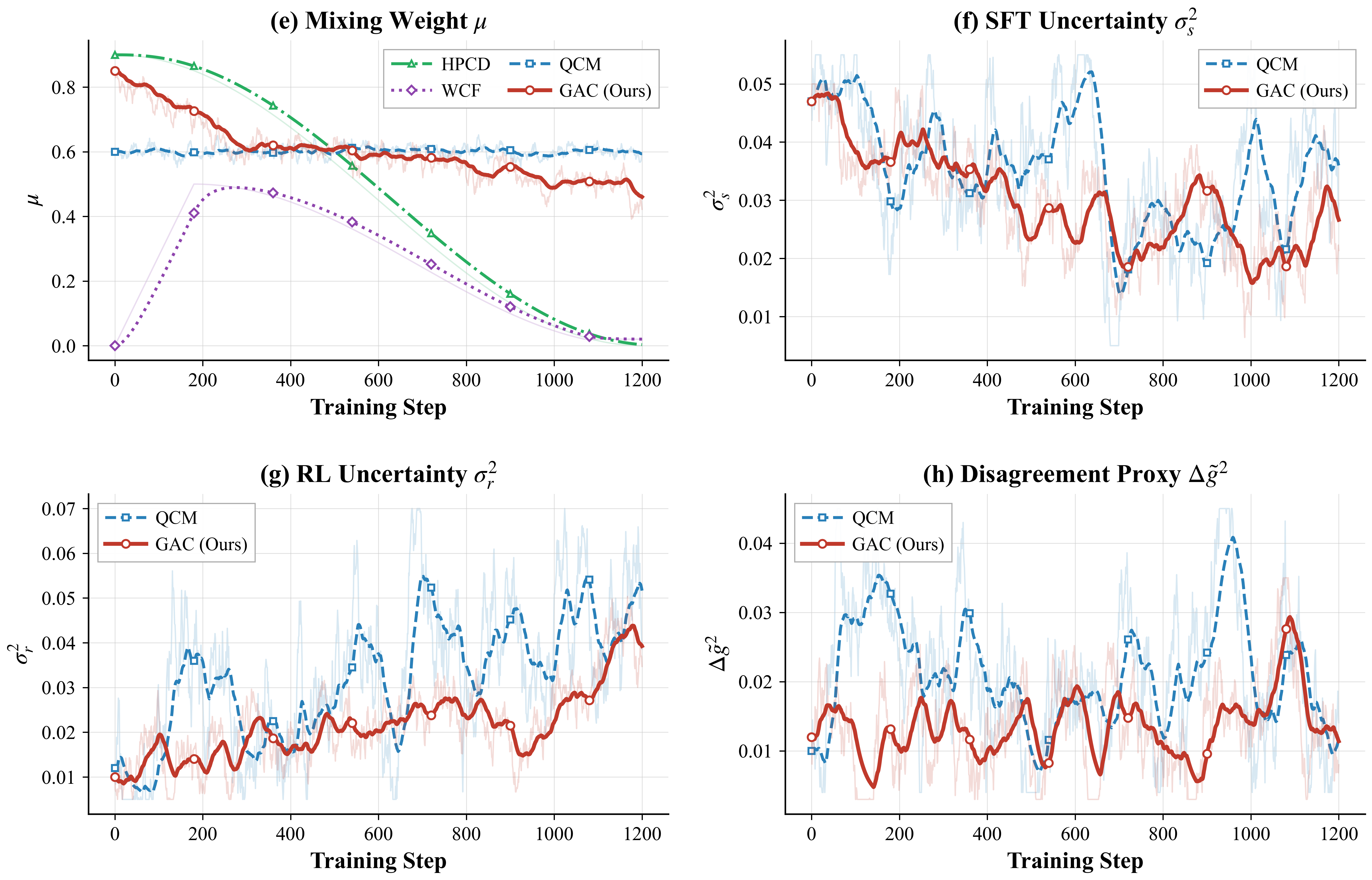
that balances SFT noise, RL noise, and SFT–RL disagreement. Because gradient-level quantities are prohibitively expensive at every step, we introduce three coefficient-space proxies — estimated online from tensors any GRPO/PPO trainer already computes — and wrap them in a guarded update stack: EMA smoothing, a cosine-schedule prior, per-step change capping, and hard clipping. The controller is length-invariant by construction and has less than 1% wall-time overhead.
Across math, code, science, and logic benchmarks, the noise-aware estimator alone outperforms the best rule-based baseline; the full system reaches +3.8 pp over HPT on average, while reducing KL-drift area by 28% and large |Δμ| events by more than 70%. Gains grow monotonically with model scale from Qwen2.5-1.5B to Qwen2.5-14B.